Bible Color - Color By Number
- 4.8
- Rating
- 1.00M
- Installs
- Free
- Price
 Analysis by App-foxy
I spent time with Bible Color - Color By Number as a quiet board game rather than treating it like a fast, competitive title. That distinction matters. Its appeal is not winning rounds or mastering complicated rules; it is the steady act of filling numbered areas and watching an illustration take shape. The result feels closer to a short mindful break than a conventional game session, which makes it easy to understand why the store presents it as a gentle coloring experience.
Fun Coloring World has positioned this free game for a broad audience, with an Everyone age rating and support for devices running Android 7.0 or later. It has also built a substantial audience: the game shows more than a million installs, a 4.9 average from around fifteen thousand ratings, and about 1.2 thousand written reviews. Those figures do not replace personal testing, but they do suggest that the simple format has connected with many people.
How Bible Color feels in everyday use
I find the everyday appeal comes from how easily a small pause can become a contained coloring session: I can choose one area, work through it, and stop when attention shifts. The Bible-focused artwork gives that routine a more personal tone than a general pattern book, so the next section looks at how the game’s steady feedback shapes that experience.
You May Also Like

 Blood Strike: 2.5 Anniversary
Blood Strike’s Loadouts Turn Every Drop Into a Tactical Gamble
A close look at Blood Strike’s custom loadouts: how fast access to signature weapons reshapes its battle royale rhythm, rewards preparation, and narrows the gap between fights.

 Pandora - Music & Podcasts
Pandora’s Music Is Easy to Start, but Harder to Recover
Pandora’s strength is its low-effort path from a seed to a station. Its weak spot is how much confidence it asks you to place in connection, setup, and quiet recovery.

 8 Ball Pool
 Is Built on Rivalries, Rematches, and Routine
A close look at the rivalries, rematches, shared routines, and unanswered safety questions that turn a quick pool match into a persistent mobile community.

 Samsung Music
’s Quiet Strength Is Playing What You Already Own
Its reach comes less from spectacle than from dependable access to a personal library. That simplicity is both the app’s strongest retention engine and its ceiling.

 AccuWeather: Weather Radar
AccuWeather Review: A Quick, Clear Forecast for Everyday Decisions
For everyday plans, the best forecast is the one you can understand quickly. AccuWeather makes rain timing, radar, and local conditions easy to act on, with a few trade-offs.

 Hill Climb Racing
Why Hill Climb Racing Still Turns Crashes Into One More Run
A tiny car, a bumpy hill and one more upgrade: Hill Climb Racing keeps resurfacing because its simple chaos makes every near-miss feel personal.
More From Our News Desk



A calm start instead of a demanding tutorial
The first thing I noticed is how little mental preparation the game asks from me. I do not need to learn a complicated ruleset, plan a route, or remember a long sequence of moves. The central activity is immediately readable: choose a color and apply it to the matching numbered spaces. That makes it suitable for a few spare minutes when I want something gentle, especially after work or before bed.
In a realistic everyday scenario, I could open it while waiting for an appointment, complete part of an image, and stop without feeling that I had abandoned an important match. That is one of its strongest qualities. The session does not seem to depend on a large uninterrupted block of time, so the game fits naturally into short pauses rather than demanding my full attention.
The religious artwork also gives the experience a more specific identity than a standard coloring collection. Someone looking for Bible-themed imagery may find that focus comforting and more meaningful than abstract patterns or general cartoon pictures. On the other hand, anyone who wants a broad art library with unrelated subjects may find the theme too narrow over time.
What the performance feels like during normal coloring
For this kind of game, perceived speed is less about rapid animation and more about whether the touch response feels predictable. Coloring is relaxing only when the interface lets me tap, drag, and correct mistakes without becoming a source of irritation. The simple board-game format helps here because it does not appear designed around constant action, split-second decisions, or elaborate visual effects.
I would not choose it for testing a phone’s gaming power. Its value comes from low-pressure interaction, not spectacle. That also means expectations should stay realistic: the reward is the finished picture and the calming rhythm of the process, not a deep progression system or the excitement of a competitive board game.
A useful habit is to treat each picture as a small routine. I start with the larger, easier areas when I want quick progress, then move toward the smaller sections once I am settled. This makes the session feel less fiddly and gives me a clear stopping point. It is a simple workflow, but it prevents the experience from turning into aimless tapping.
When a longer session becomes demanding
The game’s gentle nature does not mean every moment is equally effortless. Detailed coloring can become more tiring when I focus on tiny spaces for a long period. The challenge is not strategic difficulty; it is attention and touch accuracy. On a smaller screen, narrow sections may require more careful taps, while a larger display can make the picture easier to inspect.
That is an important trade-off for people who plan to use it as a longer relaxation activity. Short sessions are likely to feel more natural than extended marathons, particularly if the player is already tired or has reduced patience for repetitive work. I found the format most convincing when used as a pause between tasks, not as the only game I play for an entire evening.
Heavy use can also mean switching rapidly between colors and returning to unfinished areas. The more I try to rush, the less calming the experience becomes. My practical advice is to slow down rather than chase completion speed. The game is better when I use the coloring process itself as the point, instead of treating every image like a checklist.
Stability and recovery after interruptions
A coloring game has a particular reliability requirement: I want to feel safe leaving it briefly and coming back later. A session may be interrupted by a message, a phone call, or a low-battery warning, so recovery matters almost as much as the initial launch. The straightforward structure works in its favor because there are fewer moving parts than in an online multiplayer game or a large action title.
I still recommend closing the app normally when possible, especially after completing a meaningful amount of work. That is not a criticism unique to this game; it is sensible practice for any app where progress matters. If I am using it during a short break, I also avoid switching between many demanding apps at once. Keeping the session simple makes the overall experience feel more dependable.
Its large audience and high average rating indicate that many players have found the game satisfactory, but those numbers should not be read as a guarantee for every phone. Android devices differ widely in age, screen size, available storage, and background activity. A device that handles modern games comfortably should have little reason to struggle with this type of board experience, while an older phone may still feel slower when several apps are open.
Device limits that can change the experience
The stated minimum of Android 7.0 makes the game accessible to a wide range of Android hardware, although operating-system compatibility is only one part of the picture. A phone can meet the software requirement and still offer an awkward coloring experience if its screen is cramped, the touch panel is inconsistent, or the battery is already under strain.
Screen size is especially relevant here. On a compact phone, the image may be perfectly usable for broad areas but less comfortable when I work through small numbered sections. A tablet or larger handset would be the more pleasant choice for someone who wants to color carefully for a longer period. I would also keep the display clean and use a light touch, since pressing harder does not make detailed areas easier to select.
Resource demands are likely to feel modest compared with graphically intensive games because the core activity is static coloring rather than high-speed 3D action. Still, I would avoid promising that every device will behave identically. Older hardware, limited free space, or many background processes can affect launch time and responsiveness in any app. The sensible approach is to keep the operating system current for the device and close unnecessary apps if the interface starts feeling sluggish.
The current version is 1.93.167, and that gives prospective players a clear point of reference when checking compatibility on their own device. I would not treat a version number as proof of perfect stability, but it does make it easier to identify whether the installed copy is current before judging performance.
Where it stands beside familiar alternatives
Compared with a traditional board game, this is much more solitary and meditative. There is no need to gather players, set up pieces, or learn a shared rulebook. That makes it a poor substitute for someone seeking social competition, tactical decisions, or the satisfaction of beating an opponent. It is better understood as a digital coloring activity placed in the board category.
Compared with general coloring apps, the Bible-centered theme is its clearest point of difference. A broad coloring app may offer more variety in subjects, while this game can feel more focused for people who specifically want religious scenes. That focus is a strength when it matches my interests and a limitation when I want animals, landscapes, fashion, or abstract designs in the same place.
Compared with paper coloring books, it is more convenient when I do not want to carry supplies or clean up afterward. Digital coloring also lets me take the activity into a waiting room or onto a commute. Paper still has advantages, though: a physical page offers a different tactile feeling, no dependency on a phone screen, and a more permanent object to keep. The better option depends on whether convenience or hands-on materials matter more to me.
Free access and the cost questions worth considering
The game is free to download, which makes it easy to try without committing money at the start. There are in-app purchases ranging from $1.99 to $39.99 per item, so I would pay attention to the purchase flow if I were handing the device to a child or sharing it with family. The Everyone rating makes the game broadly approachable, but age suitability does not remove the need for sensible purchase controls.
For me, the free entry point is enough to test whether the coloring style and religious theme fit my routine. I would not buy anything immediately. I would first see whether I enjoy returning to the images, whether the screen feels comfortable, and whether the available experience already meets my needs. This is a useful approach for any free coloring game because the real question is not only whether it runs, but whether its specific artwork keeps me interested.
People who dislike optional spending may prefer to treat the game strictly as a free trial and stop there. People who find the theme especially valuable may consider an optional purchase worthwhile, but that decision should come after understanding what is being offered on the player’s own device. I would never recommend buying simply to make a relaxing activity feel more complete without first deciding how often I will actually use it.
Small techniques that make the experience better
My first practical tip is to divide a picture into visual zones instead of jumping randomly between numbers. Completing one area at a time makes progress easier to see and reduces the feeling of searching across the entire image. It also helps when I only have a few minutes, because I can finish a recognizable portion before putting the phone down.
My second tip is to reserve detailed sections for a time when I am not rushing. Tiny spaces are where impatience creates the most friction. If I am standing in a queue and likely to be interrupted, I choose broader areas first. If I am at home and want a more absorbing break, I work slowly through the intricate parts.
My third tip is to use the game as a transition ritual rather than a background distraction. I get more from it when I put aside notifications, lower the pressure to finish, and focus on a single image. That approach turns a basic tap-to-color loop into a deliberate reset. It also reveals a limitation: if I need constant novelty, the repetitive rhythm may feel too narrow.
A fourth consideration is accessibility of attention. The game’s simple interaction may suit someone who finds complex controls tiring, but detailed visual work can still be difficult for players with eyesight or touch-precision challenges. A larger device may help, and people who need stronger accessibility controls should compare it with alternatives that provide more display or input customization.
Who should choose it, and who should skip it
I would recommend it to someone who wants a quiet, faith-oriented coloring activity that can be opened for a short break. It is also a reasonable choice for families looking for an Everyone-rated game with an uncomplicated premise, provided adults manage purchases appropriately. The free price makes experimentation straightforward, and the low-pressure format is more approachable than a strategy-heavy board game.
I would steer competitive players elsewhere. If the reason I download a board game is to challenge friends, make tactical decisions, or feel a strong sense of victory and defeat, this will probably seem too passive. I would also hesitate to recommend it to someone who wants an endless range of unrelated artwork, because the Bible theme is central rather than incidental.
It may not be ideal for people who become frustrated by repetitive tapping or who expect every session to introduce a new mechanic. The game’s strength is consistency, and consistency can feel like sameness if I am looking for variety. In that situation, a broader coloring app or a conventional multiplayer board game would be a better match.
My performance verdict
After weighing speed expectations, longer-session comfort, stability, and device limits, I see Bible Color - Color By Number as a deliberately modest game that succeeds by keeping its purpose clear. It does not need demanding graphics or complicated systems to be useful. Its best performance is measured by how easily it lets me settle into a picture, pause when necessary, and return without turning relaxation into work.
The developer, Fun Coloring World, has made a focused board-category game rather than a universal coloring toolbox. That focus gives it a recognizable audience: players who appreciate Bible-themed images and want a calm digital activity. The current version is 1.93.167, and Android 7.0 or later is required, so owners of older devices should check that basic compatibility before expecting a smooth start.
My final view is positive, with clear boundaries. I would install it for quiet breaks, reflective coloring, and simple sessions that do not punish interruption. I would skip it when I want social play, strategic depth, broad artistic variety, or a high-energy challenge. The right reason to choose it is not excitement; it is the dependable feeling of making slow, visible progress in a theme that matters to you.
FAQs for Bible Color - Color By Number
01What is Bible Color - Color By Number?
Bible Color - Color By Number is a mobile app designed for both relaxation and spiritual reflection. It combines coloring activities with inspirational Bible verses, allowing users to unwind while engaging with meaningful content. The app offers a wide variety of biblical themes and images, making it a unique blend of art and spirituality.
02How does the coloring process work in the app?
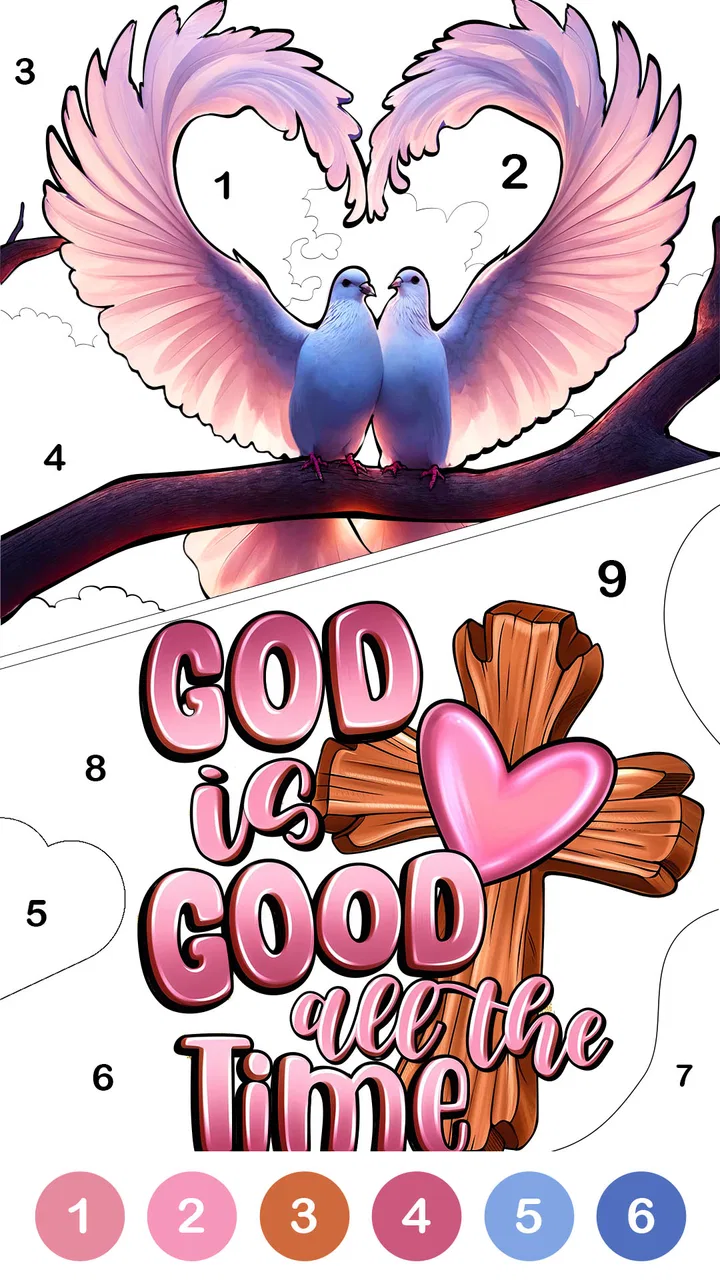
The app provides a seamless coloring experience by using a color-by-number system. Each section of the image is marked with a number corresponding to a specific color. Users simply tap on the numbers to fill in the sections, gradually revealing a complete, vibrant image. This method is intuitive and accessible for all ages.
03Is an internet connection required to use Bible Color?
While the app can be accessed offline, an internet connection is recommended for the best experience. Downloading new images and content updates requires internet access. However, once images are downloaded, they can be colored offline, allowing users to enjoy the app anywhere without connectivity issues.
04Are there in-app purchases or subscriptions?
Bible Color - Color By Number offers both free and premium content. While the app is free to download and includes a selection of images, some additional content and features may require in-app purchases or a subscription. This model allows users to enhance their experience with exclusive images and tools.
05Is the app suitable for all age groups?
Yes, Bible Color - Color By Number is designed to be family-friendly and suitable for all ages. The app features easy-to-use controls and a variety of images that appeal to both children and adults. Parents can feel confident that the content is appropriate and enriching for younger users.
Pros
- Easy-to-use interface for all ages.
- Wide variety of biblical images to color.
- Offline mode available for convenience.
- Includes daily inspiration quotes.
- No intrusive ads during coloring.
Cons
- Limited free images without subscription.
- Occasional app crashes on older devices.
- Requires internet for updates.
- In-app purchases can add up quickly.
- Color palette could be more diverse.

Bible Color - Color By Number
Gallery